Showing posts with label Alan Turing. Show all posts

June 3, 2016

Is this the real life? Is this just fantasy?

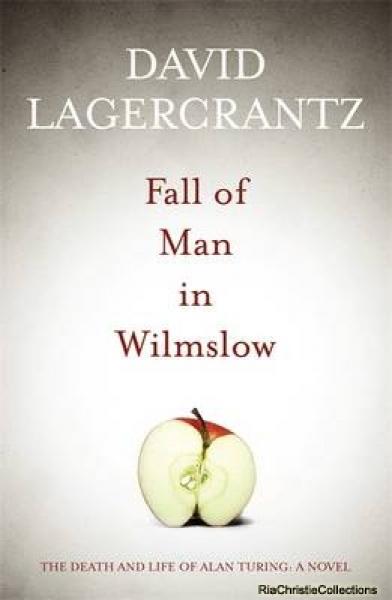
Honestly, I spent the entirety of this book fully convinced I was reading a nonfiction book about Alan Turing from the point of view of the policeman who found his body. Good job, David Lagercrantz! You totally fooled me! The book in question is Fall of Man in Wilmslow and it's the fictionalized story of Alan Turing's suicide and his contribution to the war effort and to numerous academic disciplines. Over the last year or more, I've been pretty much obsessed with all things A.I. and as a result I've learned a great deal about Alan Turing (and I've talked about him a few times here if you remember) who is considered the father of the modern computer AND Artificial Intelligence. What a guy! As a result, I'm pretty familiar with the biographical points of his life and his death. That's partially why I thought this was a work of nonfiction because all of those facts were laid out...which is the perfect way to build a fantastic piece of historical fiction. Lagercrantz used just enough of the truth to weave a convincing story about what might have happened had the policeman who found him been somewhat like Turing himself. Detective Constable Leonard Corell is the first officer on the scene and at first he is disgusted by not only the act of suicide itself but the man who committed it. This disgust turns into a kind of rage when he discovers that Turing was convicted of homosexuality. Even his initial aversion doesn't tamp down his horror at the punishment meted out by the government however. (He was chemically castrated which many believe was the main reason he chose to end his life as it led to severe depression.) Corell is an odd character. He flip flops between being overconfident in his abilities to allowing himself to be railroaded by his peers and bosses. He's also constantly daydreaming which I found tiring by the end of the novel. Speaking of the end of the novel, I didn't like it. It felt like the book was building and building and then the end was such a letdown. I can't say more about it without giving away huge spoilers but let's just say it was closely tied into Corell's daydreams. If you're completely unfamiliar with Turing and his work then this is an interesting way to get clued in because as I said much of the story is completely factual. Excepting the end, I really did enjoy this book. Lagercrantz is an excellent storyteller and he fooled me into thinking this was entirely plausible. 8/10 because that ending bummed me out.


Source: abebooks.com


**If you're interested in buying this book or any books really, you can click here or here. The first will re-direct you to AbeBooks and the second will re-direct you to The Book Depository. These are great websites for purchasing books (AbeBooks carries inexpensive used and out-of-print books and The Book Depository ships free everywhere in the world). Full disclosure: I will receive a commission on all sales made by following either of these links. I wouldn't recommend a site that I didn't use and you are under no obligation to purchase anything. :-) **

July 14, 2014

Turing: The Unsung Hero

The message that I got from Turing: Pioneer of the Information Age is that he never got any of the credit that he rightfully deserved. The main reason for this is that a lot of the groundbreaking work that he did was at Bletchley Park and it had to be kept secret. Therefore, a vast majority of the credit for the development of the modern computer, stored programming, and artificial intelligence was given to others (both American and English). In fact, history books and textbooks on computer science up until fairly recently made no mention of the two men that were behind the development of modern computers: Alan Turing and Thomas Flowers. Turing was truly ahead of the times with his theories that computers could be 'taught' and that artificial intelligence was an inevitable part of our future (the fear is real within me, guys). Unfortunately, much of his findings on this went either unpublished or unseen and once again other scientists got the jump on him. (At this point, I have to say that this is just the opinion of one man but the overwhelming evidence backs him up.) I learned what the 'imitation game' is and also discovered I had read about it before in Our Final Invention: Artificial Intelligence and the End of the Human Era by James Barrat. The author only briefly touched on the tragic end to Turing's life and suggested that the case may not have been a cut and dry suicide after all. You'll have to read the book to get the full details! ;-)

You might remember when I reviewed Russell Brand's My Booky Wook. If you don't I encourage you to click on the title of the book which will take you to that entry so you can catch up. Basically, it was a fantastic read and I somehow managed to finish it while on Thanksgiving holiday at all of the theme parks in Florida. *inspirational music playing* Therefore, I have high hopes for Booky Wook 2: This Time It's Personal. According to the book jacket the follow-up is going to focus on the sexual mayhem that only a sex addict can get up to and how the power of love (awkward now isn't it?) can cure all. I have a feeling this one will be anything but boring.

Update coming your way soon but until then happy reading!!

July 9, 2014

Technological progress from the modern computer to robots that have ethics

Well, it probably comes as no surprise that I thoroughly enjoyed I, Robot. This was my introduction into the genius mind of Isaac Asimov and I'm not going to stop here. I didn't realize until about midway through this book when I started looking at other books by him that this is the first in The Robot Series. The other three novels follow the detective exploits of a human and humanoid robot team so you know that's going on the TRL. As I said in the last entry, this book covers various scenarios in which robots acted outside of their prescribed programming. I liked that the stories were separate yet they had recurring characters and an overarching narrative theme. This kept things moving along and makes the reader invested (only if the author makes the characters likable or interesting which Asimov definitely did). By the end, you get the gist of what he is trying to say and most likely what the remainder of the series will explore: machines making decisions for humanity as a whole. For most, this fills them with a sense of horror that their lives are no longer their own to control. However, for one character in I, Robot this was almost comforting as robots had 'perfect logic and reason' and since one of the fundamental laws of robotics is to keep humans safe they will always make decisions in our favor. I highly recommend that you read this one to get the entire picture because I know I'm not doing it near enough justice.


Further in the vein of technological advances, my next read is Turing: Pioneer of the Information Age by B. Jack Copeland. I became aware of the name Alan Turing when I saw the trailer for The Imitation Game which is all about how he and his team at Bletchley Park cracked the Enigma code during WWII. It's a shame but I don't think many people are aware of this man despite his many accomplishments. Computers are based off of his invention the Universal Turing Machine. He was a leader in the field of mathematics, artificial intelligence, and biology. However, his genius was overshadowed for several years because he was convicted of homosexuality, chemically castrated (his choice instead of imprisonment), and then committed suicide by cyanide poisoning. More recently, there has been talk regarding the reversal of charges against him -- years too late. I have a feeling this one's gonna be a tearjerker, guys, so get those tissues ready!