Showing posts with label artificial intelligence. Show all posts

December 3, 2021

Intriguing concept with excellent follow-through

AI 2041: Ten Visions for our Future by Kai-Fu Lee and Chen Quifan is a unique undertaking. AI 2041 seeks to explore the way that AI (Artificial Intelligence) will advance and change over the next twenty years. Both authors have experience in the tech fields (Kai-Fu in particular as he owns and operates a venture capital that focuses on technology). However, after leaving their respective jobs at Google they took very different career routes. Chen has pivoted to become a successful sci-fi writer using his knowledge and experience to create realistic stories with a science fiction slant. This book is a combination of their two vocations.

There are 10 short sci-fi pieces written by Chen that delve into different existing (and evolving) technologies powered by AI through a realistic lens. At the end of each story, Kai-Fu discusses in detail why he believes these advances in AI will have sufficiently progressed by the year 2041 to make these stories seem less like science fiction and more like science fact. Some of the topics discussed like deep learning (we're seeing the beginnings of it now with Google Maps following where we've been and making suggestions) and the mechanization of the workforce (this has been happening for years but in twenty years time we could see major industries like medicine, education, and construction almost entirely taken over by AI) have been developing for decades. 

Each of the stories was so well-written and the analyses were so fascinating that at times I forgot my absolutely debilitating fear of Artificial Intelligence (until I read the section on autonomous vehicles). This is a great read for fans of sci-fi, technology, or futurology. And it's one of the few short story collections I've read in recent memory where each of the offerings could stand on its own. (And I actually recall more than half of them after finishing it roughly 3 days ago.) 10/10


What I'm currently reading: Fan Fiction: A Mem-Noir Inspired by True Events by Brent Spiner

**If you're interested in buying any of these books or any books really, you can click here. This will re-direct you to AbeBooks which is a site I use all of the time to find used books at an excellent price. A lot of the time I don't even pay for shipping! Full disclosure: I will receive a commission on all sales made through this link. You will not be charged anything additional for my commission. I wouldn't recommend a site that I didn't use and you are under no obligation to purchase anything. :-) **

February 8, 2020

Too many robots?

When I read Stories of Your Life and Others in 2017 I was blown away by Ted Chiang's writing. It's unique to find a short story collection where so many of the stories are standouts (and memorable) but his first collection managed to do both. I found it mind-boggling that he hadn't written more so when I heard Exhalation was coming out I added it to my library holds list. With the memory of the stories from the first book still pretty fresh in my mind, I went into Exhalation with high expectations...and was slightly disappointed. This collection veered much more strongly toward artificial intelligence and existentialism while his previous work was varied (and exceptional). The best story from this collection was actually Exhalation which was about robots constructed with artificial lungs (yes, it's creepy). I can't really remember any of the rest except one about a robotic nanny which had a great philosophical bent to it. Quite a few stories were novella length which I think contributed to why it didn't feel as diversified as the first collection since not as many stories could be included. (A/N: Many of the stories were collected from various publications over the years and some are as old as 10 years.) That isn't to say that I didn't still appreciate his artistry as a writer because without a doubt he is a brilliant wordsmith but when you come out of the gate with such a winner like Stories of Your Life and Others it can be difficult to reach that height again. ¯\_(ツ)_/¯  My overall assessment: 6/10

Source: Amazon

What's Up Next: Will My Cat Eat My Eyeballs by Caitlin Doughty
What I'm Currently Reading: Do You Mind if I Cancel? (Things That Still Annoy Me) by Gary Janetti

**If you're interested in buying this book or any books really, you can click here or here. The first will re-direct you to AbeBooks and the second will re-direct you to The Book Depository. These are great websites for purchasing books (AbeBooks carries inexpensive used and out-of-print books and The Book Depository ships free everywhere in the world). Full disclosure: I will receive a commission on all sales made by following either of these links. I wouldn't recommend a site that I didn't use and you are under no obligation to purchase anything. :-) **

December 14, 2018

No gold stars awarded here

The Fourth Age: Smart Robots, Conscious Computers, and the Future of Humanity by Byron Reese could have been really good if only it wasn't riddled with so many grammatical errors. :'-( Repeated words, completely missing words, and words in the wrong order (was this down to the editor?) were liberally spread through the entire book which really took away from my enjoyment. I felt that what he was trying to accomplish with this book was interesting but I'm not entirely sure that he accomplished his goal (and he certainly needs to do a more thorough job of editing). This was less a purely scientific look at artificial intelligence and more a philosophical one about the nature of consciousness and if it's even remotely possible to duplicate it in a computer matrix. As with philosophical books, there were more questions raised than answers proposed. For all of the books on AI that I've read this one rests at the bottom and you'd be better served reading something along the lines of In Our Own Image by George Zarkadakis for a well-executed and researched work on the subject. Additionally, major points taken off for a lack of a bibliography. I have no idea how you can reference so many other people's work and then give them absolutely no credit. 2/10

Source: Amazon

What's Up Next: 5 Worlds Book 2: The Cobalt Prince by Alexis & Mark Siegel with illustrations by Boya Sun & Matt Rockefeller

What I'm Currently Reading: Guns, Germs, and Steel by Jared Diamond and The Science of Supervillains by Lois H. Gresh & Robert Weinberg

**If you're interested in buying this book or any books really, you can click here or here. The first will re-direct you to AbeBooks and the second will re-direct you to The Book Depository. These are great websites for purchasing books (AbeBooks carries inexpensive used and out-of-print books and The Book Depository ships free everywhere in the world). Full disclosure: I will receive a commission on all sales made by following either of these links. I wouldn't recommend a site that I didn't use and you are under no obligation to purchase anything. :-) **

June 16, 2017

Am I no longer afraid of robots?

The Wild Robot by Peter Brown has both fascinated me and frightened me for at least 2 months now. I kept seeing the cover when I was shelving or visiting other branches and the image of the single robot standing on top of a pile of rocks kept leaping out at me. I finally gave up the fight when I decided that middle grade fiction was the way to cure my book reading blues. I'm glad that I did because The Wild Robot was a lot of fun to read (and it turns out it's the start of a series!) made even more amazing by the superb illustrations supplied by the author. [A/N Peter Brown is no stranger to creating books as he's a well-known children's picture book author/illustrator but this is his first attempt at middle grade fiction.] This isn't your standard 'robot story' but instead it's a look at climate change, the ever-evolving landscape of our world with the advent of technology, and what it means to be truly alive. In short, it's beautiful, thought-provoking literature. The illustrations peppered throughout enhance the story by adding depth to the characters (I love that they're black and white.). Roz is doing the best she can given her circumstances which is really all that anyone can do. The only difference is that she's an artificial lifeform living on an island without any humans. How will this shape her? Will her presence have any effect on the local fauna and flora? Brown's commentary on our world is perfectly geared for a younger audience but it wouldn't go amiss for the adult crowd either. ;-) I can't wait to see how this story continues to develop as Peter carries on with the series. 10/10

For a look at the book from the author's perspective check out this awesome post written by Peter about his process of getting his book published: "The Wild Robot lives!".

The haunting cover. [Source: Amazon.com]
Source: New York Times

**If you're interested in buying this book or any books really, you can click here or here. The first will re-direct you to AbeBooks and the second will re-direct you to The Book Depository. These are great websites for purchasing books (AbeBooks carries inexpensive used and out-of-print books and The Book Depository ships free everywhere in the world). Full disclosure: I will receive a commission on all sales made by following either of these links. I wouldn't recommend a site that I didn't use and you are under no obligation to purchase anything. :-) **

May 9, 2017

Sculpting the future

Longtime readers of the blog will recall that I've had a certain fear fascination with robots and A.I or Artifical Intelligence. You can check out my posts about books like Our Final Invention which details the growth artifical intelligence into super intelligence or In Our Own Image which is a thought experiment about what the evolution of AI will look like in the future to get an idea of what I mean. Today's book is somewhere in the middle. How to Build an Android: The True Story of Philip K. Dick's Robotic Resurrection by David F. Dufty covers the creation of a robotic incarnation of the famous sci-fi author which (according to its creators) has the ability to learn as it communicates with humans i.e. it is self-aware. The novelty of this machine was that it was created in the image of a man who was known for his paranoia about 'thinking' machines and that it was an artistic as much as technological acheivement. This book chronicled the creation of the android from its inception including the sculpting of the head and body by Dr. David Hanson through to its programming by Andrew Olney. (Not to mention the many volunteers from the FedEx Institute of Technology in Memphis who logged many hours helping to make this dream a reality without any compensation.) The PKD android was a sensation among scientific circles as well as among laypeople because of his realistic facial features, expressions, and his seemingly intelligent responses to questions. However, I am not convinced that he would have passed the Turing Test which proves that he was a self-aware artificially intelligent machine. Moreover, I found this book was lacking in many areas. Each of the chapters seemed to end without any real resolution and the ending fell flat. Also, one of my pet peeves is a nonfiction book without any endnotes or at the very least a bibliography and this one committed that sin. Overall, I'd say that this book would appeal to someone who hasn't done any significant research into this field and wants to dip their toe into that world but for me it didn't make the grade. 5/10

If you want to see the PKD android in action then you can check out the Hanson Robotics website. Be forewarned, if the idea of a seemingly artificially intelligent machine with human-like characteristics freaks you out then you shouldn't go to that website. To see what I mean, take a look at the pictures below. *shudder*

Source: Ascend Surgical
Source: Philip K. Dick Android Project


**If you're interested in buying this book or any books really, you can click here or here. The first will re-direct you to AbeBooks and the second will re-direct you to The Book Depository. These are great websites for purchasing books (AbeBooks carries inexpensive used and out-of-print books and The Book Depository ships free everywhere in the world). Full disclosure: I will receive a commission on all sales made by following either of these links. I wouldn't recommend a site that I didn't use and you are under no obligation to purchase anything. :-) **

June 14, 2016

A love letter to the literary giants of science fiction

I had high hopes for Arkwright by Allen Steele because the premise sounded so promising. A sci-fi book about a sci-fi author (touted as being a contemporary of Isaac Asimov) that bankrolled a gargantuan scientific project that could only be cooked up by a sci-fi enthusiast? Yes, please! The basic outline of this book is that through multiple generations of one family, the Arkwright clan, an interstellar space craft would be created and launched into the vast reaches of space in the hopes of colonizing a distant planet for future human inhabitation. Each section of the book focused on a different descendant of the original creator, Nathan Arkwright. The major problem for me was that I didn't especially like any of these characters. It isn't a necessity to like the characters you read about of course but it helps if you feel invested in them because otherwise their actions make no difference to you one way or the other...which is what happened to me. Halfway through, I almost gave this book up as a lost cause but I decided to soldier through in the hopes that the ending would knock my socks off. It did and it didn't. You can probably guess what the last chapter of a book about interstellar travel will contain but if you're looking for a huge crescendo then you're going to be disappointed. When I was contemplating giving this one up I looked up other reviews and someone mentioned how it would have been better if the ending had been expanded further. I agree. By focusing on the management of the company, the fiscal pitfalls, the construction of the ship, and the foibles of each of the family members Steele missed an opportunity to really knock it out of the park. If you're a huge sci-fi nerd (as I am) then you most likely won't fall in love with this book but if you're new to the genre or a fan of the generation ship trope then maybe this one will be a win for you. 4/10 for a great concept that didn't really deliver.


**If you're interested in buying this book or any books really, you can click here or here. The first will re-direct you to AbeBooks and the second will re-direct you to The Book Depository. These are great websites for purchasing books (AbeBooks carries inexpensive used and out-of-print books and The Book Depository ships free everywhere in the world). Full disclosure: I will receive a commission on all sales made by following either of these links. I wouldn't recommend a site that I didn't use and you are under no obligation to purchase anything. :-) **

June 3, 2016

Is this the real life? Is this just fantasy?

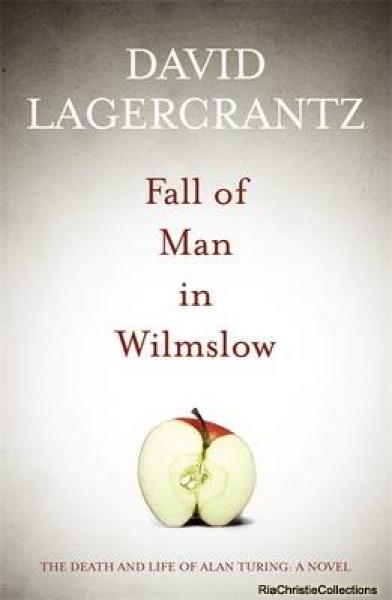
Honestly, I spent the entirety of this book fully convinced I was reading a nonfiction book about Alan Turing from the point of view of the policeman who found his body. Good job, David Lagercrantz! You totally fooled me! The book in question is Fall of Man in Wilmslow and it's the fictionalized story of Alan Turing's suicide and his contribution to the war effort and to numerous academic disciplines. Over the last year or more, I've been pretty much obsessed with all things A.I. and as a result I've learned a great deal about Alan Turing (and I've talked about him a few times here if you remember) who is considered the father of the modern computer AND Artificial Intelligence. What a guy! As a result, I'm pretty familiar with the biographical points of his life and his death. That's partially why I thought this was a work of nonfiction because all of those facts were laid out...which is the perfect way to build a fantastic piece of historical fiction. Lagercrantz used just enough of the truth to weave a convincing story about what might have happened had the policeman who found him been somewhat like Turing himself. Detective Constable Leonard Corell is the first officer on the scene and at first he is disgusted by not only the act of suicide itself but the man who committed it. This disgust turns into a kind of rage when he discovers that Turing was convicted of homosexuality. Even his initial aversion doesn't tamp down his horror at the punishment meted out by the government however. (He was chemically castrated which many believe was the main reason he chose to end his life as it led to severe depression.) Corell is an odd character. He flip flops between being overconfident in his abilities to allowing himself to be railroaded by his peers and bosses. He's also constantly daydreaming which I found tiring by the end of the novel. Speaking of the end of the novel, I didn't like it. It felt like the book was building and building and then the end was such a letdown. I can't say more about it without giving away huge spoilers but let's just say it was closely tied into Corell's daydreams. If you're completely unfamiliar with Turing and his work then this is an interesting way to get clued in because as I said much of the story is completely factual. Excepting the end, I really did enjoy this book. Lagercrantz is an excellent storyteller and he fooled me into thinking this was entirely plausible. 8/10 because that ending bummed me out.


Source: abebooks.com


**If you're interested in buying this book or any books really, you can click here or here. The first will re-direct you to AbeBooks and the second will re-direct you to The Book Depository. These are great websites for purchasing books (AbeBooks carries inexpensive used and out-of-print books and The Book Depository ships free everywhere in the world). Full disclosure: I will receive a commission on all sales made by following either of these links. I wouldn't recommend a site that I didn't use and you are under no obligation to purchase anything. :-) **
February 26, 2016

History, science, and robots...what more can you ask for?


I started reading In Our Own Image: Savior or Destroyer? The History and Future of Artificial Intelligence by George Zarkadakis with the naive idea that he would definitively answer the question "Will robots destroy the human race?" Instead he's done something even better. He's given a comprehensive history of mathematics, philosophy, psychology, computer science, and Artificial Intelligence. He's explained how our evolution as a species is directly related to the possibility (and the success) of the creation of AI. I'm always amazed when reading scientific nonfiction to discover just how much of the history I already know (Turing! Aristotle!) and how much I am woefully ignorant of (Godel and so much more). AI has been in the works for years. Scientists have approached it from a variety of standpoints and for a multitude of purposes. One of the biggest hurdles facing the scientific community is whether or not consciousness is programmable in a computer. A machine can be "intelligent" but does it exhibit intelligence in the same way as humans? Can a machine understand the true meaning of the questions that it answers through the logic programs installed in its hardware? No one really knows. Is it possible to map the human brain and recreate this mechanically inside of an android? Probably. Is humanity ready for machines that look like us, act like us (to an extent), but are more efficient and intelligent than us? Doubtful. As you know, I love a good end notes and this book has a truly excellent one. I learned the difference between ontology and epistemology, that there's something called the Ig Nobel Prize, and that writers are simply "empty vessels" waiting to be filled by texts. This book asks more questions than it answers and I think that's the point. Humans are unique because we have the capacity to ask questions and to be curious. If you're looking for a thought provoking book on a truly fascinating (and still terrifying) topic then this one will definitely fit the bill.

**If you're interested in buying this book or any books really, you can click here or here. The first will re-direct you to AbeBooks and the second will re-direct you to The Book Depository. These are great websites for purchasing books (AbeBooks carries inexpensive used and out-of-print books and The Book Depository ships free everywhere in the world). Full disclosure: I will receive a commission on all sales made by following either of these links. I wouldn't recommend a site that I didn't use and you are under no obligation to purchase anything. :-) **

June 9, 2015

Bringing a whole new meaning to the term 'connected'

Think A Clockwork Orange meets I, Robot and you're on the right track to grasping the concept of Feed. If you've ever read or watched A Clockwork Orange, you'll remember the made up language/slang called Nadsat which was so complicated that a glossary was included at the back off the book. Feed isn't quite that difficult but it does take a meg long time to get used to (that was a little example there). As veteran readers of the blog will know, I am fascinated (or you could say horrified) by the theory that technology will one day destroy humanity as we know it now. One could even argue that it's already well under way. What M.T. Anderson has done is look at how corporations and the media have shaped our culture and what might happen if we surrender fully to it. This is a worst case scenario (at least I hope it is) of what happens when we cease asking questions and nourishing our natural curiosity. What if we were all tapped into the media and each other in such a way that we soon became mere vessels for corporations to exploit? Would life find a way? Find out by reading Feed and letting your imagination run wild.
  
(I am actually reading The Historian by Elizabeth Kostova now.) A young woman stumbles upon letters written by her father which detail a quest to find out the truth about Vlad the Impaler (aka the guy who inspired Dracula). She must decide if she wants to follow in her father's footsteps and seek to unravel the mysteries that might just cross over into modern times...

July 14, 2014

Turing: The Unsung Hero

The message that I got from Turing: Pioneer of the Information Age is that he never got any of the credit that he rightfully deserved. The main reason for this is that a lot of the groundbreaking work that he did was at Bletchley Park and it had to be kept secret. Therefore, a vast majority of the credit for the development of the modern computer, stored programming, and artificial intelligence was given to others (both American and English). In fact, history books and textbooks on computer science up until fairly recently made no mention of the two men that were behind the development of modern computers: Alan Turing and Thomas Flowers. Turing was truly ahead of the times with his theories that computers could be 'taught' and that artificial intelligence was an inevitable part of our future (the fear is real within me, guys). Unfortunately, much of his findings on this went either unpublished or unseen and once again other scientists got the jump on him. (At this point, I have to say that this is just the opinion of one man but the overwhelming evidence backs him up.) I learned what the 'imitation game' is and also discovered I had read about it before in Our Final Invention: Artificial Intelligence and the End of the Human Era by James Barrat. The author only briefly touched on the tragic end to Turing's life and suggested that the case may not have been a cut and dry suicide after all. You'll have to read the book to get the full details! ;-)

You might remember when I reviewed Russell Brand's My Booky Wook. If you don't I encourage you to click on the title of the book which will take you to that entry so you can catch up. Basically, it was a fantastic read and I somehow managed to finish it while on Thanksgiving holiday at all of the theme parks in Florida. *inspirational music playing* Therefore, I have high hopes for Booky Wook 2: This Time It's Personal. According to the book jacket the follow-up is going to focus on the sexual mayhem that only a sex addict can get up to and how the power of love (awkward now isn't it?) can cure all. I have a feeling this one will be anything but boring.

Update coming your way soon but until then happy reading!!

October 15, 2013

I almost wish this WAS only science fiction

Artificial Intelligence, or AI, is not something only relegated to science fiction. It is a reality. Most people immediately think of their smartphones but what about the machinery that powers cities? Would you consider that to be a facet of AI? It could be argued that because many pieces of an electrical grid are run without human interference (or understanding as to why certain parts work the way that they do) that it is a type of AI. However, the book Our Final Invention is about what happens when AI turns from AGI (Artificial General Intelligence) to ASI (Artificial Super Intelligence). At that stage, machinery becomes self-sufficient, self-aware, and self-improving. It's surpassed human intelligence and can continue to improve itself and become even more intelligent. Barrat believes that at this point the machinery which should not be compared to humans will not have "feelings" about its creators. It will wipe us out in its quest to fulfill its own goals and agendas. Replication on a global scale will occur and all matter than can be used for that purpose will be used even if that matter is humanity as a whole. There are some decidedly scary concepts housed within the pages of this book. As if to ram the point home I ran across this article today which talks about the rapid growth of Artificial Intelligence and how the vast majority of the populace is completely unaware of the advances being made RIGHT NOW. Chilling, eye-opening stuff. Conspiracy theorists will be eating this book up.

Blood Work: A tale of medicine & murder in the scientific revolution by Holly Tucker is more than just a history of blood transfusions. It is more than historical nonfiction wrapped up in scientific jargon. It is a political discourse on humanity and its moral and political evolution. The same issues that plagued people in the 17th century seem to be plaguing us today. Is it morally wrong to experiment on humans if it will help the human race as a whole? Is it an abomination against God to put animal's blood inside of a person's body in the hopes that it will help them to survive? I have no idea if this book will even come close to answering these questions but I'm fairly positive it will raise even more intriguing questions while delivering a fascinating depiction of science unfolding.

September 29, 2013

SCIENCE!

Well, when he titled it My Brief History, Stephen Hawking wasn't kidding. It was very brief. It's difficult to review because I felt like it only skimmed the surface of his life. It started with his childhood and made its way up to the present and all of his scientific and personal victories in between. The illustrations were the icing on the cake (I'm a sucker for family photographs by the way) and lent a personal touch to an otherwise very straightforward autobiography. Hawking's writings are witty and self-deprecating and this was no different. However, I would have preferred that it wasn't written a little more personally. At times, it felt like he would get caught up in science excitement only to remember that he was supposed to be writing about himself. (Not that I don't like science excitement, guys.) I liked it but it didn't hold a candle to A Brief History in Time (which is currently residing on my desk at work 3/4 finished) in my opinion.

If you've seen the movie I, Robot or read the book Robopocalypse  then you're familiar with the concept of a world where Artificial Intelligence takes over and the human race is doomed. The difference between those two stories and the book that I'm reading is that Our Final Invention: Artificial Intelligence and the End of the Human Era is a work of nonfiction. That's right: NONFICTION. James Barrat explores what will most likely happen once we've developed a self-aware AI that hones survival skills to outmatch those of the human race. Why wouldn't it do anything in its powers to survive? Would it stop to mourn human lives that it had to snuff out to reach its goals? Can machines even feel? I'm suddenly reminded of Bicentennial Man with Robin Williams and AI with Haley Joel Osment. Both of those movies simultaneously fascinated and horrified me. We created a life that so closely mirrored our own and yet they were vastly superior to us. We tried to keep them subservient while also imbuing them with human emotions. It was miserable on both sides and ultimately had unfortunate consequences. The thought that this could (and quite possibly already is) happen is frightening indeed.