Showing posts with label philosophy. Show all posts

January 6, 2021

Back in the saddle again with my first review of 2021!

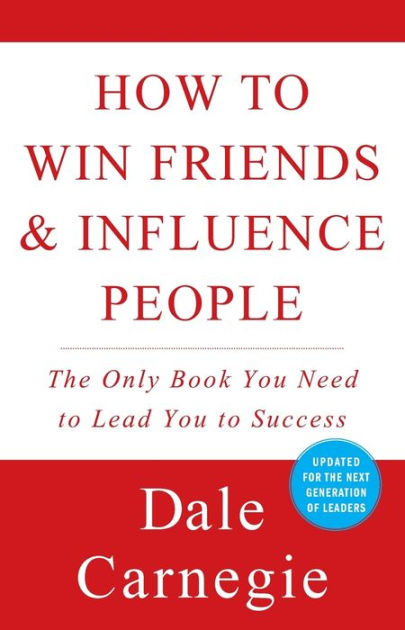
I started a book at the end of 2020 and I closed the cover on it yesterday. It came highly recommended to me by my good friend, Karen. (Hey, Karen!) This book has been around since the 1930s and has been published in many languages and countries and yet it had never been on my radar before. I'm of course talking about How to Win Friends & Influence People by Dale Carnegie. This book began as an educational tool to accompany the classes that Carnegie was teaching on Human Relations and Public Speaking and was intended for the business professionals who were then enrolled in his courses. It has since been updated and revised multiple times as its appeal grew to encompass people from all walks of life around the globe. I confess to feeling a bit skeptical about this book and I think that's entirely due to its somewhat lofty promise on its cover.

At its core this is a philosophical book about self-confidence and the interconnectedness of the human race. The historical anecdotes were especially interesting as they ran the gamut from diplomats, politicians, and presidents to bank managers, sales clerks, and parents. While this book was originally intended for business professionals, ultimately it's helpful for anyone wanting to build confidence and interpersonal skills. There's a reason it's still popular 70 years later. 8/10
Source: Barnes & Noble


What I'm currently reading: Single. On Purpose. by John Kim and The Vanishing Act of Esme Lennox by Maggie O'Farrell

**If you're interested in buying any of these books or any books really, you can click here. This will re-direct you to AbeBooks which is a site I use all of the time to find used books at an excellent price. A lot of the time I don't even pay for shipping! Full disclosure: I will receive a commission on all sales made through this link. You will not be charged anything additional for my commission. I wouldn't recommend a site that I didn't use and you are under no obligation to purchase anything. :-) **

February 8, 2020

Too many robots?

When I read Stories of Your Life and Others in 2017 I was blown away by Ted Chiang's writing. It's unique to find a short story collection where so many of the stories are standouts (and memorable) but his first collection managed to do both. I found it mind-boggling that he hadn't written more so when I heard Exhalation was coming out I added it to my library holds list. With the memory of the stories from the first book still pretty fresh in my mind, I went into Exhalation with high expectations...and was slightly disappointed. This collection veered much more strongly toward artificial intelligence and existentialism while his previous work was varied (and exceptional). The best story from this collection was actually Exhalation which was about robots constructed with artificial lungs (yes, it's creepy). I can't really remember any of the rest except one about a robotic nanny which had a great philosophical bent to it. Quite a few stories were novella length which I think contributed to why it didn't feel as diversified as the first collection since not as many stories could be included. (A/N: Many of the stories were collected from various publications over the years and some are as old as 10 years.) That isn't to say that I didn't still appreciate his artistry as a writer because without a doubt he is a brilliant wordsmith but when you come out of the gate with such a winner like Stories of Your Life and Others it can be difficult to reach that height again. ¯\_(ツ)_/¯  My overall assessment: 6/10

Source: Amazon

What's Up Next: Will My Cat Eat My Eyeballs by Caitlin Doughty
What I'm Currently Reading: Do You Mind if I Cancel? (Things That Still Annoy Me) by Gary Janetti

**If you're interested in buying this book or any books really, you can click here or here. The first will re-direct you to AbeBooks and the second will re-direct you to The Book Depository. These are great websites for purchasing books (AbeBooks carries inexpensive used and out-of-print books and The Book Depository ships free everywhere in the world). Full disclosure: I will receive a commission on all sales made by following either of these links. I wouldn't recommend a site that I didn't use and you are under no obligation to purchase anything. :-) **

January 31, 2020

Stanislaw Lem: A Masterpost

The first book by Stanislaw Lem that I read was The Star Diaries which I absolutely loved and it got me itching to read more from him. And thus I bring you 3 different books in one post. XD

Source: Amazon
Spoiler alert: I didn't find Solaris nearly as compelling as its predecessor. The premise is that a scientist is sent to Solaris (a planet with a space station) only to discover that the 3 inhabitants which he was meant to meet have been reduced to two. Our main character, Kris Kelvin, arrives hoping to crack the enigma of the alien ocean which comprises the whole of the planet (and which is sentient). Once he arrives, strange and disturbing things start to happen such as resurrection of the dead into corporeal beings. Is the entity aware of its cruelty? Is it conducting an experiment on the scientists like the ones that it has been subjected to over the years? Have they actually gone mad?! The overarching message that Lem seems to be making is that humanity continually seeks out new worlds and beings only to impose their own values and agendas to further their reach. (Think colonialism of other cultures and peoples.) He likens it to religion and the search for redemption. (Sci-fi and philosophy go hand-in-hand more often than not as most lovers of the genre will know.) For me it's a 4/10 as I found myself putting it down and grabbing other things to read instead.

I'm kind of obsessed with these covers, ya'll. [Source: Amazon]
Now The Cyberiad completely got me back on board the Stanislaw Lem fan train. It was absolutely hysterical. This is a collection of short stories all about the adventures (or rather misadventures) of 2 (in)famous constructors as they make their way across the universe. (These journeys are called sallies which is a detail I adore.) Our heroes, Klapaucius and Trurl, are constantly trying to one-up each other not only with their creations but also with their status as constructors and benefactors to the cosmos. These robots are constructed for all kinds of constructive and inane reasons like storytelling, poetry, making war, etc. And the words that Lem makes up! I'm trying to think of a better word than delightful to describe my reading experience but honestly it was a treat to read a bit of this every night before bed. (If you don't laugh at the depiction of 'palefaces' i.e. humans then you have no sense of humor at all.) An absolute 10/10 for me. (And wait til you read the twist. O_O)

Source: Prosecraft 
Memoirs Found in a Bathtub caught my eye simply for the novelty of the title and that bizarre cover. This book is difficult to sum up or even to rate as it truly has no discernible plot. Lest you dismiss it immediately because of this fact, let me assure you that there's much to recommend this title. The word play and circuitous path of our main character (who remains nameless) is satire at its finest. Espionage, counterespionage, and counter-counterespionage abound in The Building where our character has been given a very important Mission...if only he knew what it was. He is continually beset by obstacles in the form of bureaucrats, winding halls with nondescript doors, and instructions that keep vanishing. What would happen if humanity was forced to abandon its cities and move into an underground bunker? Would society, culture, and technology survive and continue to advance?  Lem weaves a provocative tale of paranoia, confusion, and ultimately betrayal. 5/10 but would have been higher had there been a plot to follow.

What's Up Next: Exhalation by Ted Chiang
What I'm Currently Reading: The Memory Police by Yoko Ogawa

**If you're interested in buying this book or any books really, you can click here or here. The first will re-direct you to AbeBooks and the second will re-direct you to The Book Depository. These are great websites for purchasing books (AbeBooks carries inexpensive used and out-of-print books and The Book Depository ships free everywhere in the world). Full disclosure: I will receive a commission on all sales made by following either of these links. I wouldn't recommend a site that I didn't use and you are under no obligation to purchase anything. :-) **

December 28, 2019

For fans of Isaac Asimov

The Star Diaries by Stanislaw Lem (my first Polish translated work!) came into my life due to an observant patron recognizing my Star Trek tattoo as the nerd alert that it is and recommending it to me. [Hallelujah!] The book is organized into short stories touted as the numbered voyages of Ijon Tichy. [A/N: Don't be thrown by the fact they aren't in order. Read my note at the end of this review for a better understanding.] The beginning offers an introduction which has the reader questioning the 'validity' of Tichy as a narrator and the last voyage really solidifies that doubt. [We are given to believe that these chronicles are studied by dedicated scholars and that Tichy is a great explorer.] We follow Tichy as he makes his way across the universe on a solo trip which ultimately turns into a philosophical journey about the nature of being and how he fits into the grand picture of the universe. One particular story was a standout for me (and absolutely terrifying) featuring robot monks, wild furniture, and a type of humanity that was horrifying for Tichy (and the reader) to behold. (Really dig into the underlying message here.) Lem, like most good sci-fi writers, is looking at what it means to be human by tapping into our curiosity for all things that are decidedly alien or other. Tichy is our lens into a world that is as ever changing as the various voyages that he makes. I absolutely loved it. 10/10

A/N: A note at the back of the book explained that the voyages were written out of order because Lem wrote the book over the course of 20 years and his writing style changed somewhat across the span of the stories.

The cover on the book that I read. [Source: Amazon]
I just love this cover. [Source: Goodreads]

What's Up Next: So You Want to Talk About Race by Ijeoma Oluo
What I'm Currently Reading: Inside Out: A Memoir by Demi Moore

**If you're interested in buying this book or any books really, you can click here or here. The first will re-direct you to AbeBooks and the second will re-direct you to The Book Depository. These are great websites for purchasing books (AbeBooks carries inexpensive used and out-of-print books and The Book Depository ships free everywhere in the world). Full disclosure: I will receive a commission on all sales made by following either of these links. I wouldn't recommend a site that I didn't use and you are under no obligation to purchase anything. :-) **

December 14, 2018

No gold stars awarded here

The Fourth Age: Smart Robots, Conscious Computers, and the Future of Humanity by Byron Reese could have been really good if only it wasn't riddled with so many grammatical errors. :'-( Repeated words, completely missing words, and words in the wrong order (was this down to the editor?) were liberally spread through the entire book which really took away from my enjoyment. I felt that what he was trying to accomplish with this book was interesting but I'm not entirely sure that he accomplished his goal (and he certainly needs to do a more thorough job of editing). This was less a purely scientific look at artificial intelligence and more a philosophical one about the nature of consciousness and if it's even remotely possible to duplicate it in a computer matrix. As with philosophical books, there were more questions raised than answers proposed. For all of the books on AI that I've read this one rests at the bottom and you'd be better served reading something along the lines of In Our Own Image by George Zarkadakis for a well-executed and researched work on the subject. Additionally, major points taken off for a lack of a bibliography. I have no idea how you can reference so many other people's work and then give them absolutely no credit. 2/10

Source: Amazon

What's Up Next: 5 Worlds Book 2: The Cobalt Prince by Alexis & Mark Siegel with illustrations by Boya Sun & Matt Rockefeller

What I'm Currently Reading: Guns, Germs, and Steel by Jared Diamond and The Science of Supervillains by Lois H. Gresh & Robert Weinberg

**If you're interested in buying this book or any books really, you can click here or here. The first will re-direct you to AbeBooks and the second will re-direct you to The Book Depository. These are great websites for purchasing books (AbeBooks carries inexpensive used and out-of-print books and The Book Depository ships free everywhere in the world). Full disclosure: I will receive a commission on all sales made by following either of these links. I wouldn't recommend a site that I didn't use and you are under no obligation to purchase anything. :-) **

October 20, 2018

Raw, unfiltered, and achingly honest

When Breath Becomes Air by Paul Kalanithi is a posthumous memoir/biography from a man who was both in the prime of his life and the beginning of what promised to be an illustrious career as a neurosurgeon and neuroscientist. The terminal lung cancer which was already making its way through his spinal column wasn't part of the plan...and yet Paul chose to meet this challenge head-on as a way to understand and learn how the inevitability of death can be explored by those shepherding the way. How does the mind and brain (seen as two separate entities here) play a role in this? He first approached this topic through the lens of literature which he had always been interested in (hence the beginning of the book which would eventually be published after his death) but he then moved on to his direct experience as a doctor and then as a patient. Paul was interested in the bigger picture of what exactly death means and he kept trying to parse it out by asking, "Where did biology, morality, literature, and philosophy intersect?" (pg 41). He didn't shy away from the ugly underbelly of cancer treatment and how it's seen from both a medical professional's standpoint (best practices, proven remedies, etc) and the one receiving the care (uncertainty, despair, anger, and frustration to name a few). Facing mortality and asking the tough questions are the overarching themes of When Breath Becomes Air but this is also a quiet story about a man coming to terms with the fact his life was about to end. I don't want to give away all of the details because I really think you should read this one if you never read another book about death (although why stop here?). I didn't know if I'd be able to continue it at several points (there were tears) because it mirrors so much of what my dear friend, Jessica, went through during her battle with cancer. But I am happy that I persevered. 10/10

This quote blew my mind because I feel I'm constantly justifying to people why I do the work that I do even though some of it doesn't compensate me at all (the blog) and the one that does is probably never going to make me financially solvent (children's librarian). Looking at the bigger picture is hard if you are cutting out the crucial bits like death which comes for us all.
Indeed, this is how 99 percent of people select their jobs: pay, work, environment, house. But that's the point. Putting lifestyle first is how you find a job - not a calling. - pg 68-69
If I remember correctly this was a quote from Paul's wife and I think it perfectly encapsulates why this is such an important book. It's why I've read and reviewed so many books around this topic over the past year.
Paul confronted death - examined it, wrestled with it, accepted it - as a physician and a patient. He wanted to help people understand death and face their mortality. Paul's decision not to avert his eyes from death epitomizes a fortitude we don't celebrate enough in our death-avoidant culture. - pg 215
Source: Amazon

Side note of interest (at least to me): Lucy, Paul's widow, found love again with a recently widowed father of two...who's spouse also wrote a book about her journey of dying. That book is The Bright Hour: A Memoir of Living and Dying by Nina Riggs and yes it's totally going on my TRL.

What's Up Next: Being Mortal: Medicine and What Matters in the End by Atul Gawande

What I'm Currently Reading: The Bear and the Nightingale by Katherine Arden

**If you're interested in buying this book or any books really, you can click here or here. The first will re-direct you to AbeBooks and the second will re-direct you to The Book Depository. These are great websites for purchasing books (AbeBooks carries inexpensive used and out-of-print books and The Book Depository ships free everywhere in the world). Full disclosure: I will receive a commission on all sales made by following either of these links. I wouldn't recommend a site that I didn't use and you are under no obligation to purchase anything. :-) **

October 6, 2018

To stoke your wanderlust

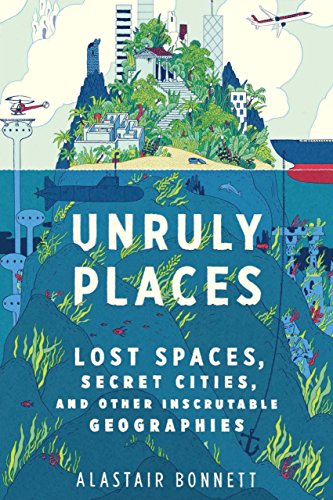
Unruly Places: Lost Spaces, Secret Cities, and Other Inscrutable Geographies by Alastair Bonnett is essentially a sociological and philosophical study of what 'place' really means to each of us. The author explores 47 different locales around the globe (usually with GPS coordinates included) and divides them by type (floating cities, underground bunkers, and places without borders to name a few). He examines the dichotomy in wanting a place which is set in stone and also desiring to be itinerant travelers like our ancestors. Until I read this I had never really thought about the significance that we as humans associate with place. The historical and geographical facts Bonnett detailed were especially fascinating (examples include: pumice rafts, Sealand (they have their own passports!), and the enclaves of Belgium). The pacing was just right and the material kept me engaged throughout (which by this point in the year is a challenge).  I really like to learn about places that are far removed from the everyday and Bonnett delivered on that in spades. For those with wanderlust in their heart or a desire to learn about phenomenally odd and/or out of the way locales then this is a great little book. I bet it would make an excellent travel companion on any vacation! 10/10

Source: Amazon

What's Up Next: When Breath Becomes Air by Paul Kalanithi

What I'm Currently Reading: Star Trek: Destiny #3: Lost Souls by David Mack (yes, I'm still reading this)

**If you're interested in buying this book or any books really, you can click here or here. The first will re-direct you to AbeBooks and the second will re-direct you to The Book Depository. These are great websites for purchasing books (AbeBooks carries inexpensive used and out-of-print books and The Book Depository ships free everywhere in the world). Full disclosure: I will receive a commission on all sales made by following either of these links. I wouldn't recommend a site that I didn't use and you are under no obligation to purchase anything. :-) **

December 24, 2017

What thoughts do eggs have?

Everyone's a Aliebn When Ur a Aliebn Too by Jomny Sun was an odd little book.  The reader follows our main character who is an alien (or aliebn if you prefer) sent to earth to learn about humans but because he's never met one he assumes every living thing he sees is a human. Therefore, he becomes good friends with a tree, beaver, egg, etc. Reminiscent of Find the Good, this book is chock full of life lessons about what truly matters. Our little alien friend learns how to be content and happy, what loneliness is, how to be a good friend, the value of creativity, and most of all how to accept oneself. There's also an underlying message about doomsday and what the planet would be like without human habitation. Is this actually an apocalyptic tale cloaked behind a cute alien story?  I have to point out that the misspelling (as you see in the title) was highly annoying even after I managed to somewhat successfully ignore it and took away some enjoyment from the overall reading of the book. However, if you are able to look past that (and I was mostly successful) then it's a nice little read with great messages. This author isn't afraid to tackle tough subjects and I believe he does so with sensitivity and insight. This would make a great gift for that introspective friend (or a great addition to your own collection). I'd say it was a solid 7/10 because while it was a really nice book it didn't blow me out of the water. (The best graphic novel remains The Gigantic Beard That Was Evil by Stephen Collins.)

Source: Barnes & Noble

Source: Sweet


What's Up Next: Midnight at the Bright Ideas Bookstore by Matthew J. Sullivan

What I'm Currently Reading: it's 1 day til Christmas...do you think I'm reading?

**If you're interested in buying this book or any books really, you can click here or here. The first will re-direct you to AbeBooks and the second will re-direct you to The Book Depository. These are great websites for purchasing books (AbeBooks carries inexpensive used and out-of-print books and The Book Depository ships free everywhere in the world). Full disclosure: I will receive a commission on all sales made by following either of these links. I wouldn't recommend a site that I didn't use and you are under no obligation to purchase anything. :-) **

December 20, 2017

Thinking ahead

Have you guys ever watched a TED Talk? Well, apparently some of those Ted Talks are turned into published works so that the ideas can be delved into a little deeper. (To see more you can visit their website here. (They haven't asked me to review today's book by the way.)) I hadn't watched David Rothkopf's talk but The Great Questions of Tomorrow was featured in my regular 'what's new at Simon & Schuster' email and it seemed to be calling my name. Rothkopf is exploring a very wide and diverse range of topics with a central theme of  'what does this mean for the future?' running through them all. I guess it should come as no surprise that this book thoroughly freaked me out while at the same time fascinating me. Have you thought about the future of drone warfare and whether or not it might constitute the necessity for intelligent machines to have rights as members of society? WELL, NOW YOU ARE. He jumped from frightening scenarios like that to ones that hadn't even occurred to me such as complete mobile banking which would see the demise of physical currency and brick and mortar banks. O_O I especially enjoyed his take on government and how we should be trying to elect leaders who not only understand technology but can look towards the future to prepare accordingly. His example of how this was not done was that just because there was one shoe bomber it shouldn't mean we have to remove our shoes at airports into perpetuity. All in all, it was a fascinating read that I zipped right through. It's great for the people in your life (or yourself!) that enjoy philosophical discussions about the future and how actions of today and yesterday have and should continue to have direct bearing on how we handle events in the future. 10/10

Rothkopf's original TED Talk "How fear drives American politics":


What's Up Next: Find the Good: Unexpected Life Lessons From a Small-Town Obituary Writer by Heather Lende

What I'm Currently Reading: Mine Own Execution by Nigel Balchin

**If you're interested in buying this book or any books really, you can click here or here. The first will re-direct you to AbeBooks and the second will re-direct you to The Book Depository. These are great websites for purchasing books (AbeBooks carries inexpensive used and out-of-print books and The Book Depository ships free everywhere in the world). Full disclosure: I will receive a commission on all sales made by following either of these links. I wouldn't recommend a site that I didn't use and you are under no obligation to purchase anything. :-) **

December 19, 2017

This is bona fide angst

I have to assume that a large majority of you studied the epic poem, Beowulf, when you were in high school. If you recall, this is often cited as the oldest example of an epic poem in Old English and it tells the story of the hero, Beowulf, who comes to aid a king who is plagued by a monster known as Grendel. It goes on to discuss Beowulf's homecoming and his continuing adventures (with a dragon no less). All I remember of the poem was a fight in a cave. (Clearly I was unimpressed with this work's historical lineage.) So it might come as a surprise that when I saw Grendel by John Gardner I was intrigued by discovering that it was a kind of retelling of the poem in narrative format...from Grendel's point of view. Straight out of the gate, this was an absolutely bizarre piece of literature. I came away from it thinking that it was too cerebral for me (Farewell hubris!) because there were many times I felt like I had absolutely no clue what was going on. I think part of this lies with the narrative style which mixed Old English language (like the original) with contemporary phraseology (curses galore, ya'll). I was nearly tempted to reread Beowulf for reference. (Spoiler alert: I didn't.) This is a philosophical novel that ponders the nature of existence and what it actually means to be 'good' or 'evil' because for something to be truly 'good' there needs to be a corresponding 'evil' to balance it...right? Grendel is a classic example of an antihero but boy does he jaw on and on and on about his place in the universe. I found him bitter and whiny but I don't know if that's due to characterization or if it's the author's 'voice' projected onto the character. I guess I'll have to decide if I want to read more of Gardner's works to find out the answer. It's hard for me to sum up my feelings on this one other than to say it wasn't an especially enjoyable time and I don't know who I'd recommend this one too because it's very niche. It's a 2/10 for me.

I mean how could I pass up a weird cover like this? [Source: Amazon]

What's Up Next: The Great Questions of Tomorrow by David Rothkopf

What I'm Currently Reading: Mine Own Executioner by Nigel Balchin (and also Scythe which apparently I'm never going to finish)

**If you're interested in buying this book or any books really, you can click here or here. The first will re-direct you to AbeBooks and the second will re-direct you to The Book Depository. These are great websites for purchasing books (AbeBooks carries inexpensive used and out-of-print books and The Book Depository ships free everywhere in the world). Full disclosure: I will receive a commission on all sales made by following either of these links. I wouldn't recommend a site that I didn't use and you are under no obligation to purchase anything. :-) **

October 21, 2016

Never Google chicken hatcheries. Trust me.

For the last couple of years, I haven't eaten beef or pork. Part of this was dietary but the larger portion was due to my distaste with the way these animals are dealt with in the food industry. After reading Sapiens: A Brief History of Humankind I have decided to stop eating all meats for good. I'd be quite surprised if others reading this book didn't feel the same way. (This will make sense later.) This book covers exactly what the title says. Yuval Noah Harari touches on almost every aspect of what it means to be human. I can see why this book could be contentious in some circles as he is of the belief that consumerism, imperialism, and communism are religions instead of merely ideologies. He has a no holds barred attitude about the way in which humans have ravaged the planet and taken advantage of others of our species as well as flora and fauna. (Remember the no eating chicken thing?) What was most intriguing about Sapiens were the questions that he raised about the nature of happiness. There have been many books about how to be happy but no research into how happiness is measured and its trends throughout the years. (Maybe he has an upcoming novel in the works.) If you're interested in culture, human evolution, and a unique perspective of the world then you're likely to enjoy this book. I will say that a lot of this was common knowledge and/or already known to me as an Anthropology major. The second half of the book is where it got really interesting. I love a good thought experiment and trying to figure out answers to seemingly unsolvable problems is my idea of a good time. :-) I'd give this book a solid 8/10.

**If you're interested in buying this book or any books really, you can click here or here. The first will re-direct you to AbeBooks and the second will re-direct you to The Book Depository. These are great websites for purchasing books (AbeBooks carries inexpensive used and out-of-print books and The Book Depository ships free everywhere in the world). Full disclosure: I will receive a commission on all sales made by following either of these links. I wouldn't recommend a site that I didn't use and you are under no obligation to purchase anything. :-) **

July 5, 2016

Defying categorization

The following book was kindly sent to me by the self-published author, Erik Von Norden, who requested a review. Thanks for your patience! :-)

The book in question is titled Theory of Irony: How Jesus Led to Moon Golf and I struggle to categorize it. It's historical, philosophical, satirical, and many things in between. At its heart this is a factual account of all things ironic throughout history. The book covers everything from the great philosophers and theologians of the past to Jesus himself (hence the title). I vacillated between really loving this book to being extremely confused by it. The confusion lies in the huge leaps that this book makes between factual accounts to the author's sidetracked thoughts. There were times it almost felt memoir-ish. I think I would have preferred this to be more streamlined and to the point. However, I wouldn't say no to a memoir by this author because I like his narrative voice very much. If you're a fan of history and you like a snarky writing style then I think you'd really like this one. It's an interesting look at how society has seemingly said one thing and done the exact opposite over and over again. Humans are strange creatures indeed. Overall, I found this book to be thought-provoking and I'd give it a solid 6/10.

**If you're interested in buying this book or any books really, you can click here or here. The first will re-direct you to AbeBooks and the second will re-direct you to The Book Depository. These are great websites for purchasing books (AbeBooks carries inexpensive used and out-of-print books and The Book Depository ships free everywhere in the world). Full disclosure: I will receive a commission on all sales made by following either of these links. I wouldn't recommend a site that I didn't use and you are under no obligation to purchase anything. :-) **

April 12, 2016

Sometimes you need a list of bullet points

All About Love: New Visions by bell hooks (pseudonym of Gloria Jean Watkins) was the March book from the feminist book club on Goodreads called Our Shared Shelf started by Emma Watson. The title is exactly what this book is about i.e. the study of love in a new light. Each chapter is about a different aspect of love like romantic, community, spiritual, etc. She's definitely a liberal feminist (which makes sense with the book club) so her insight is skewed in that direction (if that is an issue for you). There is a religious bent to this book so if that's not your cup of tea...  Sociology, yes...at least I thought so until now. I don't know if it was the subject matter or the writing style but I found this book to be a bit of a bore and a chore. There were certain moments where I was like "ah yes this is good" but they were far outweighed by the feeling of "how many more pages til the end?" unfortunately.

Thoughts I had while reading this book:
  • This could have been an article or an essay.
  • I would have preferred this to have been approached in a more scientific (specifically hard sciences) way.
  • A lot of this is common sense.
In conclusion, I wasn't a huge fan of this. I didn't hate it but I don't think I'll be seeking this author out for any more of her books in the future. You win some, you lose some. *shrugs*


Source: science-all.com


**If you're interested in buying this book or any books really, you can click here or here. The first will re-direct you to AbeBooks and the second will re-direct you to The Book Depository. These are great websites for purchasing books (AbeBooks carries inexpensive used and out-of-print books and The Book Depository ships free everywhere in the world). Full disclosure: I will receive a commission on all sales made by following either of these links. I wouldn't recommend a site that I didn't use and you are under no obligation to purchase anything. :-) **


February 26, 2016

History, science, and robots...what more can you ask for?


I started reading In Our Own Image: Savior or Destroyer? The History and Future of Artificial Intelligence by George Zarkadakis with the naive idea that he would definitively answer the question "Will robots destroy the human race?" Instead he's done something even better. He's given a comprehensive history of mathematics, philosophy, psychology, computer science, and Artificial Intelligence. He's explained how our evolution as a species is directly related to the possibility (and the success) of the creation of AI. I'm always amazed when reading scientific nonfiction to discover just how much of the history I already know (Turing! Aristotle!) and how much I am woefully ignorant of (Godel and so much more). AI has been in the works for years. Scientists have approached it from a variety of standpoints and for a multitude of purposes. One of the biggest hurdles facing the scientific community is whether or not consciousness is programmable in a computer. A machine can be "intelligent" but does it exhibit intelligence in the same way as humans? Can a machine understand the true meaning of the questions that it answers through the logic programs installed in its hardware? No one really knows. Is it possible to map the human brain and recreate this mechanically inside of an android? Probably. Is humanity ready for machines that look like us, act like us (to an extent), but are more efficient and intelligent than us? Doubtful. As you know, I love a good end notes and this book has a truly excellent one. I learned the difference between ontology and epistemology, that there's something called the Ig Nobel Prize, and that writers are simply "empty vessels" waiting to be filled by texts. This book asks more questions than it answers and I think that's the point. Humans are unique because we have the capacity to ask questions and to be curious. If you're looking for a thought provoking book on a truly fascinating (and still terrifying) topic then this one will definitely fit the bill.

**If you're interested in buying this book or any books really, you can click here or here. The first will re-direct you to AbeBooks and the second will re-direct you to The Book Depository. These are great websites for purchasing books (AbeBooks carries inexpensive used and out-of-print books and The Book Depository ships free everywhere in the world). Full disclosure: I will receive a commission on all sales made by following either of these links. I wouldn't recommend a site that I didn't use and you are under no obligation to purchase anything. :-) **

December 18, 2015

What does it mean to be human?

Oddly enough, when I came up with the title of this blog I was really only thinking about the second book that I read this past week but it actually applies to both in a strange way.

Some of you might recall that I started reading a series which was a retelling of The Wizard of Oz with Dorothy as a villain. The last novella that I read (a prequel) concerned how Dorothy ended up back in Oz and how she came to be worse than all of the witches combined. This time around I learned about the Tin Woodman in Heart of Tin. I have to admit that I didn't find as much enjoyment in this book as I have in most of the others. I'm not sure if it's because I finished up The Lunar Chronicles and it kinda blew this series out of the water or if I just didn't care for the Tin Woodman's storyline as much. (In point of fact, I think it's a combination of the two.) This book is fairly straightforward. We see just how far Tin is willing to go to win over the heart of his one true love, Dorothy. I'm trying to come up with a delicate way of describing his preoccupation with Dorothy who is a teenager but all I can come up with is icky. The best part of Heart of Tin is that we get a few tantalizing glimpses of the schemes that Scarecrow and Glinda are cooking up behind Dorothy's back. I have a feeling that his story, The Straw King, is going to be a doozy. (Don't worry, I've already placed it on hold at the library.)

The next book that I read over the last week was Sophie's World: A Novel About the History of Philosophy by Jostein Gaarder. It's an international bestseller which for some reason I had never heard of until suddenly I found it on my library holds list (I don't remember placing it there but I guess one night I was cruising the library website half asleep). It's translated into English from Norwegian so that might be why it caught my eye (Remember my obsession with Swedish translations? I'm branching out.) or it could be because it's a book on philosophy. I had little to no knowledge about the great philosophers of the past or even what it meant to be a philosopher. I can happily say that is no longer the case. Not only did I learn about it but I experienced what it means to think philosophically...and I may have had an existential crisis as a result. The book starts out with Sophie who discovers a letter in her mailbox asking her questions such as "Who are you?".  It snowballs into packets of lecture notes and suddenly she finds herself enrolled in a philosophy course with a professor who prefers to remain hidden. I don't want to give any more away because it's better to experience it for yourself. I guarantee you'll be scratching your head and asking "Who am I?" by the end.

And now a tantalizing little teaser! I was recently contacted by a publishing company, History of the World, which is interested in creating educational books for children. Of course, I'm on board with that! The book they're starting off with is called The Amazing History of Technology and from the sample I was sent I can tell that this is a winner. It's full of beautifully illustrated scenes from history which chart the history of technology through the ages (I mean duh look at the title. I doubt it was going to be about hairstyles.). Each illustration is accompanied with the name of the creator and/or the name of the device along with the year it was created. This would be a fantastic gift for either the educators (hello, teaching aid!) or the tiny information absorbers in your life (that's children if you were confused). And for the techno geeks among you, it's accompanied by an educational app. Maybe you were looking for the perfect stocking stuffer. If so, you're welcome. ;-)

You can go here to order it

By the way, this is my 200th post. *confetti falls from the ceiling*