Showing posts with label espionage. Show all posts

June 26, 2021

Slough House: A Masterpost (so far)

I thought I'd do a masterpost on the Slough House series by Mick Herron (at least at the point I've gotten to which is to the 4th book). If you're a fan of the spy thriller genre then this is a real fun time. (Thanks to the patron who recommended it to me!) Full transparency: I read the first two books a couple of months ago so I'm copying over my reviews from other sites. 😁

Source: StoryGraph

In Slow Horses we are introduced to the characters of Slough House (basically MI5 rejects for a variety of reasons) who have been relegated to paperwork and other drudgery under the watchful eye of their supervisor Jackson Lamb (a unique character for sure). While all of the inhabitants of Slough House (called slow horses by their erstwhile colleagues in Regent's Park) are featured at different points in the story we mainly follow the newest arrival, Robin Cartwright, as he tries to come to terms with his new situation. [A/N: Because this is the first in a series, there's a lot of information about how The Service operates as well as introductions on all of the main characters (some more fleshed out than others to keep up the mystique).] Robin begins to suspect that something is afoot when he is sent on his first assignment outside since his transfer more than 6 months before. The story builds and builds upon itself adding layer upon layer of mystery with many moving parts. But because it's so compelling and fast-paced readers should be able to follow the threads easily (and finish super quickly). If you like fast-paced spy thrillers with a host of complicated characters (not all likable) then this book will definitely fit the bill.

Source: StoryGraph

Dead Lions finds us once again among the slow horses of Slough House as they complete their day-to-day meaningless tasks. But then a spy who has been out of the game for years turns up dead and Jackson Lamb is on the case...if there is one. While Lamb, Ho, Cartwright, and Standish try to unravel the mystery of this death Harper and Guy are tasked with babysitting a visiting Russian who could prove to be an asset. [A/N: I personally found the dead man's death much more interesting than the Russian diplomat (it felt forced).] It wasn't quite as electrifying as the first in the series but I really liked that it picks up right after the conclusion of the previous book (even if there are still loose threads).

Source: StoryGraph

The List is a novella length story which revisits our friends in Slough House but focuses primarily on some new recruits to the team as well as the fallout from the bombshell that occurred in the previous book (don't worry no spoilers here). The best bits were inevitably those revolving around Jackson Lamb, the fearless leader of this ragtag gang of misfits. When a spy/informant from the old days dies, it is discovered that he had been playing shadow games and keeping secrets from his handler. Can this mistake be hushed up and rectified or are they all in greater danger than they originally feared? Lots of talk about the 'craft' of being a spy in this one which was interesting but I think its short length hampered the storyline.

Source: StoryGraph

This book started out really strong with the kidnapping of maybe my favorite character (can you guess who this is?). All hands are on deck to try and recover their erstwhile colleague but it's Cartwright that really goes above and beyond by making his way through the defenses of Regent's Park to get classified information for the kidnappers. This one gave me the same feeling as the first in the series like a proper 'spy thriller' with all of the intrigue and suspense. Super high stakes that had me gritting my teeth at the ending so of course I immediately ordered Spook Street. 😬

What I'm currently reading: Mansfield Park by Jane Austen (reread) and Solutions and Other Problems by Allie Brosh

**If you're interested in buying any of these books or any books really, you can click here. This will re-direct you to AbeBooks which is a site I use all of the time to find used books at an excellent price. A lot of the time I don't even pay for shipping! Full disclosure: I will receive a commission on all sales made through this link. You will not be charged anything additional for my commission. I wouldn't recommend a site that I didn't use and you are under no obligation to purchase anything. :-) **

January 31, 2020

Stanislaw Lem: A Masterpost

The first book by Stanislaw Lem that I read was The Star Diaries which I absolutely loved and it got me itching to read more from him. And thus I bring you 3 different books in one post. XD

Source: Amazon
Spoiler alert: I didn't find Solaris nearly as compelling as its predecessor. The premise is that a scientist is sent to Solaris (a planet with a space station) only to discover that the 3 inhabitants which he was meant to meet have been reduced to two. Our main character, Kris Kelvin, arrives hoping to crack the enigma of the alien ocean which comprises the whole of the planet (and which is sentient). Once he arrives, strange and disturbing things start to happen such as resurrection of the dead into corporeal beings. Is the entity aware of its cruelty? Is it conducting an experiment on the scientists like the ones that it has been subjected to over the years? Have they actually gone mad?! The overarching message that Lem seems to be making is that humanity continually seeks out new worlds and beings only to impose their own values and agendas to further their reach. (Think colonialism of other cultures and peoples.) He likens it to religion and the search for redemption. (Sci-fi and philosophy go hand-in-hand more often than not as most lovers of the genre will know.) For me it's a 4/10 as I found myself putting it down and grabbing other things to read instead.

I'm kind of obsessed with these covers, ya'll. [Source: Amazon]
Now The Cyberiad completely got me back on board the Stanislaw Lem fan train. It was absolutely hysterical. This is a collection of short stories all about the adventures (or rather misadventures) of 2 (in)famous constructors as they make their way across the universe. (These journeys are called sallies which is a detail I adore.) Our heroes, Klapaucius and Trurl, are constantly trying to one-up each other not only with their creations but also with their status as constructors and benefactors to the cosmos. These robots are constructed for all kinds of constructive and inane reasons like storytelling, poetry, making war, etc. And the words that Lem makes up! I'm trying to think of a better word than delightful to describe my reading experience but honestly it was a treat to read a bit of this every night before bed. (If you don't laugh at the depiction of 'palefaces' i.e. humans then you have no sense of humor at all.) An absolute 10/10 for me. (And wait til you read the twist. O_O)

Source: Prosecraft 
Memoirs Found in a Bathtub caught my eye simply for the novelty of the title and that bizarre cover. This book is difficult to sum up or even to rate as it truly has no discernible plot. Lest you dismiss it immediately because of this fact, let me assure you that there's much to recommend this title. The word play and circuitous path of our main character (who remains nameless) is satire at its finest. Espionage, counterespionage, and counter-counterespionage abound in The Building where our character has been given a very important Mission...if only he knew what it was. He is continually beset by obstacles in the form of bureaucrats, winding halls with nondescript doors, and instructions that keep vanishing. What would happen if humanity was forced to abandon its cities and move into an underground bunker? Would society, culture, and technology survive and continue to advance?  Lem weaves a provocative tale of paranoia, confusion, and ultimately betrayal. 5/10 but would have been higher had there been a plot to follow.

What's Up Next: Exhalation by Ted Chiang
What I'm Currently Reading: The Memory Police by Yoko Ogawa

**If you're interested in buying this book or any books really, you can click here or here. The first will re-direct you to AbeBooks and the second will re-direct you to The Book Depository. These are great websites for purchasing books (AbeBooks carries inexpensive used and out-of-print books and The Book Depository ships free everywhere in the world). Full disclosure: I will receive a commission on all sales made by following either of these links. I wouldn't recommend a site that I didn't use and you are under no obligation to purchase anything. :-) **

November 16, 2019

Masterpost: England during World War II

Source: Amazon
For longtime readers of the blog, you'll know that I have a major interest in all things WWII and Britain. So it was kind of a no-brainer to pick up Our Uninvited Guests: The Secret Life of Britain's Country Houses 1939-45 by Julie Summers even though I had to order it through Interlibrary Loan. This book explores the history and uses of the country estates that were requisitioned by the British government for use during World War II. These uses ranged from training facilities for spies, invalid homes for injured servicemen, hospitals for pregnant women, and boarding facilities for children evacuated from London. Not only does it delve into the minutia of what the houses were used for but also what kinds of changes occurred to them (the houses that is). For some, they were never again used by their original owners. For others, the buildings much like the people themselves, were forever changed (or completely destroyed). The only thing missing from this book was an annotated bibliography (you know how much I love those) even though it is clear that Summers did her research. 8/10

Source: Amazon
While I enjoyed reading all of Summers' books, Jambusters: The Story of the Women's Institute in the Second World War was my favorite of the lot. This volume was specifically about the role that the Women's Institute (WI) performed on both the national and county levels. These women played hosts to evacuees, took over the role of primary household manager, assumed the responsibility for the nation's food production, and so much more. Not only was the WI important during the war for the nation but even more so for women who made up its membership. The main goal of the WI was to provide a space for women to socialize (there's real value in this) and educate themselves on everything from how to preserve food and stretch out their meager rations to animal husbandry. (Many local chapters kept farm animals which they then sold to raise funds for war work.) I knew that they were a social group but I had no idea just how large of a role that they played. This just reinforced how amazing women truly are. 10/10

Source: Simon & Schuster UK
By the time I got to this book I was starting to get a bit fatigued with the topic of WWII but once I got truly stuck into this book and discovered just how much I didn't know on the topic...I was hooked. Children were evacuated to the countryside during WWII (this much I knew before) but I learned that they were also sent to America, Canada, South Africa, New Zealand, and Australia. Parents weren't especially picky as long as they were away from London. This book is chock full of recollections which recall the 'waves' of children which would leave suddenly only to be called home again especially during the Phoney War when the prejudice against 'townies' coupled with the desire to see their children again prompted parents to yank their kids back to the city. Understandably, the uncertainty of the situation created a lot of anxiety among children and adults alike. The psychological trauma of abandonment had a lifelong effect on most of the children which manifested itself in a variety of ways. Some children never reconnected with their biological family while others felt their foster family was their 'true' family (some were eventually adopted and stayed in their new homes). I had never really given much thought on the intricacies of the evacuation scheme and what kind of result it had on the children and their families so this was an eye-opening reading experience. 9/10

Source: Willow and Thatch
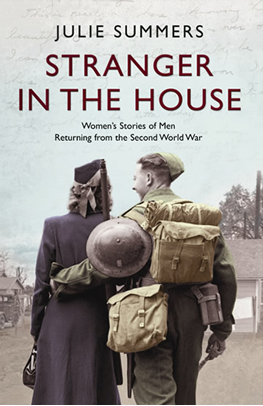
Funnily enough, I read this book last even though it was the first one that Summers wrote on the subject. Stranger in the House focuses on the men returning from the war and the effects that the war and separation from hearth and home had on themselves and the women in their lives. In the early 20th century, there was no real understanding of PTSD of which many POW (especially those who were imprisoned in the Far East and worked on the Burma Thailand Railway) suffered. On average, they were only expected to live a further 15 years because of the severity of their wounds and the maltreatment that went on for such an extended period of time. Those that lived beyond this were not considered 'lucky'. Most of the men who returned from war never again connected with their families because they were so changed and nothing of their experiences was ever discussed. Because Summers used secondhand accounts from the wives, daughters, and granddaughters coupled with primary written sources this is a unique perspective on a much discussed topic. 8/10


What's Up Next: The Gods Themselves by Isaac Asimov
What I'm Currently Reading: Kindness and Wonder: Why Mister Rogers Matters Now More Than Ever by Gavin Edwards

**If you're interested in buying this book or any books really, you can click here or here. The first will re-direct you to AbeBooks and the second will re-direct you to The Book Depository. These are great websites for purchasing books (AbeBooks carries inexpensive used and out-of-print books and The Book Depository ships free everywhere in the world). Full disclosure: I will receive a commission on all sales made by following either of these links. I wouldn't recommend a site that I didn't use and you are under no obligation to purchase anything. :-) **

July 1, 2016

Well, you can't say it's not informative

If the goal of a biography is to both inform the reader about their subject (in this case an author) and encourage them to read their subject's entire body of works then John le Carré: The Biography by Adam Sisman accomplished that goal. If you're looking for a fast-paced thrill ride then you're paging up the wrong book (did I take that metaphor too far?). Firstly, this is one of those weird occasions where the biographer's subject is still living. (I just checked and the last biography I read was I Am Scout back in May 2014 and it was also about a living (at the time) subject.) It is abundantly obvious that Sisman did his homework which is due in large part because he had the cooperation of the man himself. I must first inform you that John le Carré is not the author's true name. He is actually David Cornwell, an Englishman and former member of MI5 and MI6. (This isn't a spoiler as apparently it's a well-known fact and I'm just slow on the uptake.) A large part of Cornwell's life had been shrouded in mystery because of his prior career but in truth it was just a minor aspect of what made him into the author that he has become. Sisman explores at length Cornwell's family life and his upbringing and how that came to mold his character (and the characters in his novels). In particular, David's relationship with his father is harked upon multiple times in both Sisman's biography and in the works of le Carré. Honestly, a chronological timeline of all of Ronnie's movements wouldn't have gone amiss as that man was all over the place. I found the pacing of this book extremely slow and I felt it necessary to take frequent breaks so that I wasn't bogged down by the facts (it felt at times like I was being set up for a quiz on dates which I always fail). My overall feeling was that the book was very dry and as a result I didn't enjoy it nearly as much as I had hoped I would. :-/ However, it served the purpose of instructing me on the topic of the author known as John le Carré so there's that. So I guess I'll give it a solid 4/10 because I did find it somewhat disappointing.

I'm definitely going to check out more of John le Carré's books though. In fact, I have a copy of Smiley's People that's been lurking for entirely too long on my shelves...

**If you're interested in buying this book or any books really, you can click here or here. The first will re-direct you to AbeBooks and the second will re-direct you to The Book Depository. These are great websites for purchasing books (AbeBooks carries inexpensive used and out-of-print books and The Book Depository ships free everywhere in the world). Full disclosure: I will receive a commission on all sales made by following either of these links. I wouldn't recommend a site that I didn't use and you are under no obligation to purchase anything. :-) **

June 10, 2016

From the world that brought you Jabba the Hutt

Star Wars: Bloodline by Claudia Gray was basically an excuse to read another book from the world that created Jedi Knights, the Force, and Darth Vader. I watched and didn't especially like Star Wars: The Force Awakens and when I heard that there was a prequel to the film out there I felt compelled to read it. (It makes sense to me, okay?) The main protagonist is Senator Leia Organa and the majority of the story takes place in the Senate. This may have been why this book felt quite slow at times because it is very political and less action packed (exactly zero lightsabers made an appearance) than I had expected. Of course, this book could be viewed as a setup for the action that takes places in Star Wars: The Force Awakens. SPOILERS AHEAD FOR THIS FILM. However, there are still unanswered questions that this book did not address such as what was the final straw that broke up Han and Leia. In this book they are still happily married albeit their dedication to their jobs is already putting a strain on their relationship. Han is still a wanderer at heart and Leia is a slave to her senatorial duty. There's a division in the New Republic which spells trouble for the government that the Rebels fought so hard to obtain. I did get a bit choked up at one point because THE INJUSTICE. (If you read the book you'll understand why that had to be capitalized.) The most frustrating part of this book were the cast of characters which were introduced and didn't materialize in the movie which logically should have been the continuation of this story. I'm wondering if there is something else in between these two and that's why I felt that something was missing. All in all, it was an entertaining although not entirely satisfactory book taking place in the universe (haha space joke) of Star Wars. 7/10

**If you're interested in buying this book or any books really, you can click here or here. The first will re-direct you to AbeBooks and the second will re-direct you to The Book Depository. These are great websites for purchasing books (AbeBooks carries inexpensive used and out-of-print books and The Book Depository ships free everywhere in the world). Full disclosure: I will receive a commission on all sales made by following either of these links. I wouldn't recommend a site that I didn't use and you are under no obligation to purchase anything. :-) **

April 25, 2015

Talk about a title that's misleading...

It was immediately apparent that the main goal of Lincoln's Secret Spy was to prove that William Alvin Lloyd was absolutely not a spy. Even the end notes point out the flaws of previous works that believed this to be the case. Also, Lincoln was a peripheral figure and yet it was his picture on the cover of the book which I felt amounted to a kind of click bait for hardcovers. In fact, the authors pointed out that there were no likenesses of Lloyd on record which is why his picture is not included in the pictorial insert (although Google seems to disagree on this point Edit: The author Jane Singer has confirmed this is not William Alvin Lloyd.). If you're not a fan of minute details about train travel then I doubt you would be a big fan of this book. I applaud the authors attention to detail but I found it to be both tedious and difficult to follow because of its overuse. I know that it can be difficult to jazz up historical subjects, especially those about little known figures, but it was a bit over the top in some sections where they compared the story to a play and the reader as an audience member (or something because I honestly felt confused about their main goal with the flowery language). I saw it through to the end mainly because I kept hoping that there would be some big revelation about Lloyd that was contradictory to the rest of the book and supported the claim that he was a spy (there wasn't).

All this being said, I was inspired to go on a little quest to locate Lloyd's grave as it's located in Woodlawn Cemetery in the Bronx. It was actually a lot more arduous than I had anticipated and I spent 2+ hours trying to find it and finally had to enlist the help of a security guard. I had assumed it would be small as Virginia Lloyd, his wife, was currently quite poor at the time of William Alvin Lloyd's death. As you can see, I was very wrong.

I walked past this about 3 times before I realized it was the one.


My new friend, Mr. Security, said this was probably a part of the plot.

Here's a view of the back with my buddy, Mr. Security.

A close-up of the inscription.


Next up is The Lost World of the Old Ones: Discoveries in the Ancient Southwest by David Roberts. This story delves into the history of the Native Americans who occupied the Four Corners region of the southwestern United States. Their migration from this region along with their neighbors has been a mystery for many years. Roberts travels throughout this region searching for answers and locating artifacts unseen for the last several hundred years. My Anthropologist soul is practically thrumming with excitement over this one, guys!!

April 18, 2015

So syrupy sweet you'll wish you had pancakes

If you're in the mood for a quick, predictable romance then The Inheritance is perfect for you. As far as the historical record goes, I'm quite glad that this previously unpublished work has now seen the light of day. It's fascinating to see the first novel from one of America's most beloved authors. From a reader's perspective, however, the book fell a bit flat. It is definitely a product of the times in which it was written. The main character is without flaw and is the embodiment of what it meant to be a noblewoman. From the opening pages, I knew what the ending would be and the twists of the narrative weren't so much twists as twitches. That being said, if you are a fan of Louisa May Alcott and you're curious as to where she started from in order to reach the upper echelons of literature then you should go and pick up a copy of The Inheritance.

I believe I mentioned in my previous post that I took a little trip to the library to get some inspiration for upcoming reading. It wasn't as easy as that, however. I went to pick up a copy of Around the World in 80 Days by Jules Verne. I walked out with From the Earth to the Moon which as you might recall I read 3 years ago. *slaps forehead* After a second trip to the library, I was more fortunate (although I still didn't get Around the World in 80 Days).

Lincoln's Secret Spy: The Civil War Case That Change the Future of Espionage by Jane Singer and John Stewart is the story of William Alvin Lloyd. After Lincoln's assassination, he showed up at the White House claiming that he was hired by Lincoln as a spy and overdue for payment. Lloyd was either the Civil War's most successful spy or the most daring con man of all time. I guess we'll find out more soon!

October 10, 2014

Gotta love a good adventure story (especially when it's true)

Reading Operation Mincemeat has just convinced me that there are 1. Many more spy novels out there that I have yet to read (example: Ian Fleming) and 2. My obsession with World War II is completely justified because it was so convoluted, intriguing, and shrouded in secrecy (many of these secrets remain today). As the title suggests, this book focused on a singular operation which in itself was just a piece of a much bigger operation entitled Operation Husky (attached to another called Operation Barclay + others that were mere decoys). If nothing else, once you've finished reading this book you come away with an appreciation for the skills and ingenuity of those involved in fighting a war which for the majority of its duration seemed absolutely impossible to win. The taking of Sicily, however, proved to be a turning point in the war and Ewen Montagu and his team had a hand in the victory because they pulled off what many still believe to be the greatest feat of deception ever. If you've ever read The Man Who Never Was or seen the film version of it then you're aware of this story...except it's not the entire story because Montagu was censored by the British government (you'll see why when you read Operation Mincemeat). Sufficed to say, if you've ever fancied yourself a spy then you should read this to find out just exactly what that means. Hint: It's a lot more bureaucracy than James Bond has led you to believe.

The Lost City of Z: A Tale of Deadly Obsession in the Amazon by David Grann has been on my TRL for a while now. It's the story of a man's quest to figure out what really happened to Percy Fawcett and his expedition party. This question has haunted hundreds of people who have tried to discover the truth by following the clues left behind by the man into the very place that seems to have swallowed him alive. In 1925 Fawcett and his team (including his 21 year old son) set off on a quest to locate the lost city of El Dorado, aka Z. Now it's David Grann's turn to be enthralled by the mystery as he seeks to discover just what happened to Fawcett and his team and maybe find El Dorado himself...

March 23, 2014

Read with an eye on the past

It's important to remember the time period that a book was written in when delving into a work of classical literature. For example, The Spy came out in 1821 when American novelists were still focused on telling stories about their brethren over the pond. It was quite revolutionary (pun sooo intended) to focus a story on American soil. The story is set during the American Revolution and opens at the end of 1780. Slavery clearly still practiced and attitudes about the slaves themselves were not altogether complimentary. If you go into a work of classic literature without remembering the context of the story itself then you are doomed to find the entire body of work unpalatable. With that being said, I must say I really enjoyed The Spy. True to the style of the time there was a lot of focus on unimportant details which made a majority of the tale drag on somewhat. I felt that it didn't really pick up steam (or grab my interest) until about 3/4 of the way through. There are two fantastic characters, however, which kept me turning those pages: Captain John Lawton (of the Continental Army who is fierce, brave, and impetuous) and Harvey Birch (the spy himself who is always full of wit and intensity). These two indomitable spirits are what make this story a classic piece of American literature.

For those of you who know me outside of this blog you'll know that I have a cat. A very fat cat who has a personality as big (or bigger than) her rotund middle. So clearly the next book on my list was made for me in mind. It's How to Make Your Cat an Internet Celebrity: A Guide to Financial Freedom by Patricia Carlin with photography by Dustin Fenstermacher. I think the main premise of the book can be summed up by this sentence from the introduction: No financial opportunity will give you a greater return on investment than your cat. Flipping through the pages of the book already has me giggling as the author has paired photographs (and graphs) with semi-serious marketing strategies for raking in millions by using a cat's innate star potential. I'll read and if you don't hear from me it's because Zuzu has made me a kazillionaire.